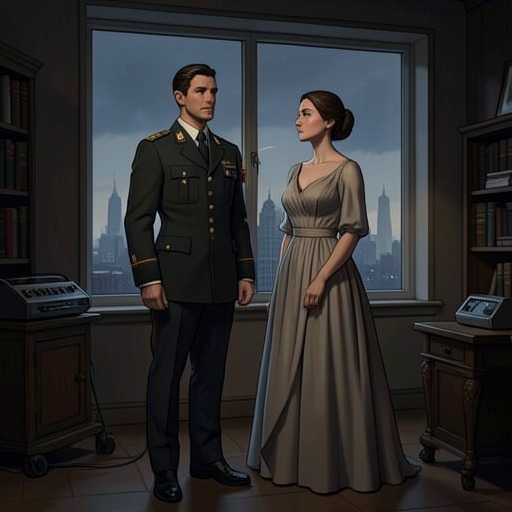
Ferdinand Bardamu and his mother
Journey to the End of the NightFerdinand Bardamu and his mother share a belated closeness founded on need, but their reunion exposes a deep divide in how they interpret suffering. When she visits him during his wartime hospitalization, her affection gives him company after other relationships have ended; at the same time, her acceptance of hardship as the poor person's appointed lot leaves him alone with a more bitter understanding of the world.
Reunion During Hospitalization
Bardamu's mother is permitted to visit him while the authorities keep him under observation. The hospital setting makes their contact precarious: his future remains unsettled, and he is among wounded men whose patriotism has been judged impaired. Her visits therefore do not signal a return to ordinary family life. They are brief access to one another within an institution that watches and assesses him.
Bardamu eventually writes to her, and she is glad to see him again. He describes her response as a mother's intense relief at having her child restored to her, while also observing that she believed the account given when he was taken away. His comparison between her trust and an animal's reliance on smell marks both tenderness and distance: affection is present, but it has not given her a clear understanding of what has happened to him.
He explains that he wrote because Lola and Musyne were gone and he had nobody left. At twenty, he says, he had only a past. The decision to contact his mother is thus driven not by reconciliation over a particular dispute but by isolation and the need to see someone familiar. Their renewed contact answers that immediate need without undoing the losses that made it necessary.
Shared Walks and Separate Worlds
After they are reunited, mother and son take long walks through the poor outskirts around the hospital. Their route passes unfinished streets, vacant lots, cheap weekly hotels, and the remnants of a city landscape shaped by poverty and wartime absence. Bardamu's account of these surroundings makes the walks more than a private family interlude: the two move together through a world whose deprivation he reads as evidence of social abandonment.
His mother speaks instead about the war as a frightening affliction that she cannot fully understand. She believes courage will see people through and treats deaths as accidents, as though the proper conduct of an individual could prevent them. Her view does not make her indifferent; she is afraid, and her attempt to explain events gives suffering a bearable shape. But Bardamu sees the difference between her consoling account and a war in which poor people are exposed to danger without control over their fate.
Their conversations also reveal the limits of their mutual understanding. His mother knows the hardships of city life and tries to make sense of rural poverty when they watch peasants working the ground. That unfamiliar misery is the only subject that draws out a particular curiosity in her. The scene reflects a larger pattern in their relationship: they can share time and observation, but each approaches hardship through the experiences she or he already knows.
Poverty, Fate, and Resignation
Bardamu's mother believes poor people are born to suffer and that their misfortunes may result from their own faults. In her view, enduring suffering can be a kindness because it gives the poor a chance to make amends. Bardamu presents this not as a passing opinion but as the foundation of her character: a resigned, tragic optimism that functions as her faith.
Her belief in fate extends to her own son's possible death. When she takes him back to the hospital, she accepts that his death may come by accident and wonders whether he is as resigned as she is. The passage shows the tenderness and the inadequacy of her care together. She does not abandon him; she accompanies him and worries about his state of mind. Yet she meets danger by seeking acceptance of it, where Bardamu's experience has made the prospect of being sacrificed impossible to treat as a comforting certainty.
The standard metre she reveres offers a small, precise parallel to this faith. She respects the official measure because the one she uses in her notions shop is a scrupulous copy of it. Her trust in a reliable standard resembles her reliance on fate: both give her an ordered point of reference in a life otherwise marked by insecurity. The comparison also underlines the difference between her need for reassuring order and her son's suspicion of the explanations that make suffering seem settled or deserved.
A Bond Without Reconciliation
Bardamu's mother is a source of real companionship at a moment when his other attachments have disappeared, but the reunion does not become a shared account of his predicament. Her tenderness cannot remove his isolation, and his account of their walks keeps her understanding of poverty and war distinct from his own. Their bond is consequently intimate in circumstance yet divided in interpretation.
That tension gives the relationship its significance in Bardamu's wartime life. His mother offers the warmth of family presence, while her faith in courage, moral fault, and resignation echoes the beliefs through which the poor are taught to accept suffering. The visits do not change his uncertain future: he is sent back to places where men are held as hostages, and he says that his future is already settled. The brief return to his mother makes that continued vulnerability more painful, because companionship is possible even when neither affection nor shared time can protect him from the system deciding his fate.